Ashavari and the Language of Becoming
By. Alicia Zamora
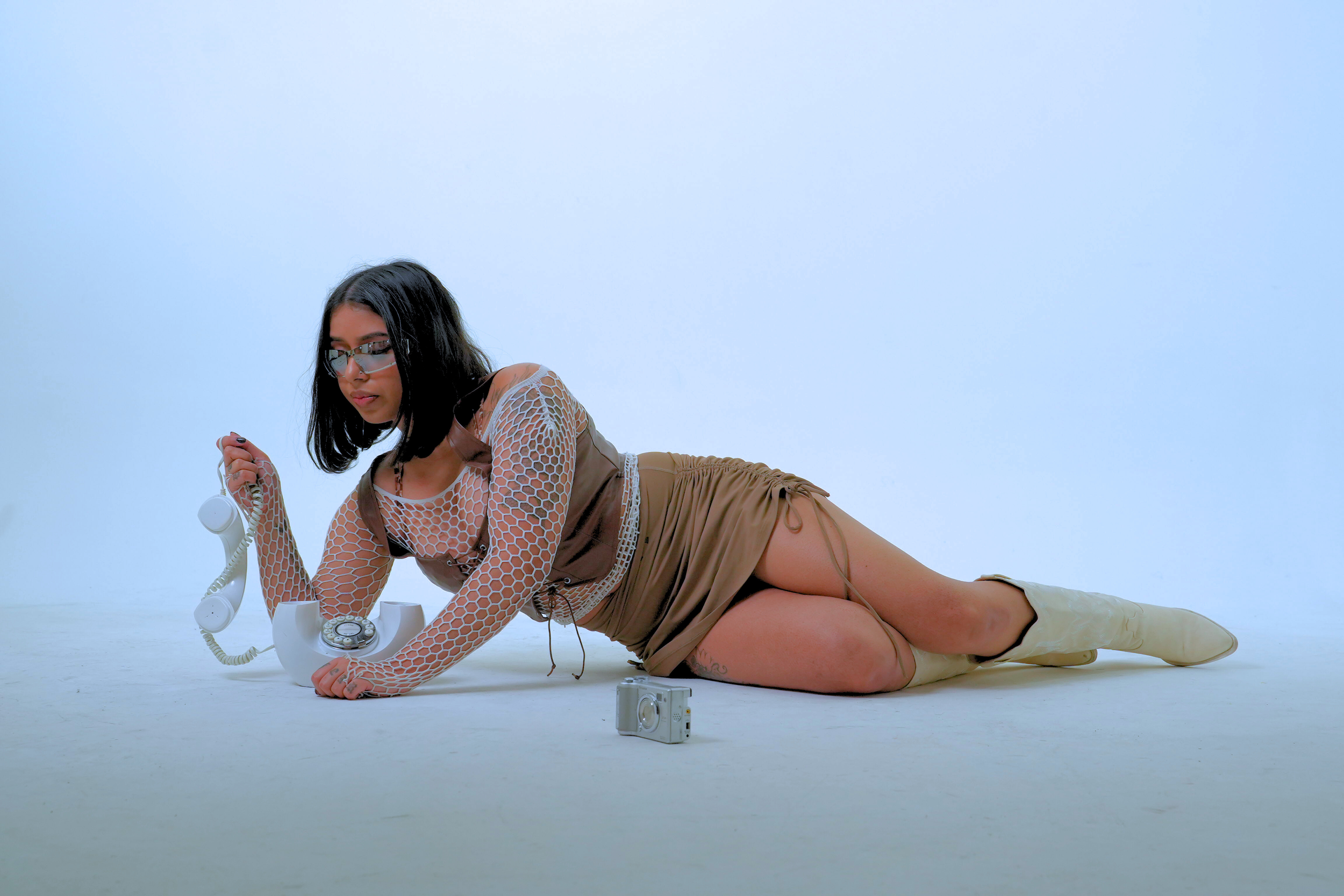
Through this interview for Alicia’s Studio, Ashavari opens up about her debut album “Goddess from the Machine”—a project that moves between memory and myth, pain and reconstruction, fragmentation and self-definition. What emerges across her answers is not just the story of an album, but the story of an artist learning how to reclaim her voice after years of having it shaped, interrupted, and misunderstood by the environments around her.
At the center of her world is a question of identity: who she is when she is not performing, adapting, or surviving. And the answer, she suggests, has always existed in pieces—waiting to be reassembled through sound.
When asked to describe herself outside of music, Ashavari doesn’t begin with a title or a genre. She begins with movement.
A curiosity that doesn’t sit still. A tendency to drift into side quests, often artistic, sometimes not. A deep pull toward nature—toward mountains, water, solitude, and silence that feels expansive rather than empty.
“I’m a curious girl that’s passionate about a lot of things,” she says, describing a life shaped by observation as much as creation.
There’s a softness in the way she describes herself, but also a restlessness. The sense of someone who is always collecting moments—watching, absorbing, remembering—before they eventually surface again as sound.
Music as a Mirror of Survival
Before listeners press play on Goddess from the Machine, Ashavari hopes they understand something fundamental: the album is not just storytelling. It is lived experience translated through survival.
The project reflects her experience as a survivor of complex PTSD with dissociative elements, but she is careful not to reduce it to trauma alone. Instead, she describes it as a window into a layered internal world—one shaped by contradiction, fragmentation, and emotional duality.
“I’m writing from a very raw place,” she explains, “but it’s also a window into the world that shaped me.”
That tension—between what is felt internally and what can be communicated outwardly—becomes one of the defining forces of her music. For Ashavari, genre was never a fixed identity. It was a limitation she eventually learned to undo.
Her work moves between dreamy textures, grunge-heavy distortion, experimental sound design, and melodic vulnerability—not as a stylistic choice, but as an emotional necessity.
She describes it as different parts of herself speaking in different sonic languages. One part drawn to softness, light, and atmosphere. Another rooted in intensity, rage, and rawness.
“It’s like bathing in sunlight vs. looking up at the moon,” she says.
Rather than choosing one version of herself, she built a structure wide enough to hold all of them.
That decision became central to Goddess from the Machine, where genre becomes a form of emotional translation rather than categorization. Singing, rapping, and even voice acting all appear not as techniques, but as responses to feeling—each one activated by intensity, clarity, or emotional weight.
Leaving and Rebuilding a Music World
Ashavari’s path through music did not begin in independence. It began in systems—progressive metal bands, collaborative projects, and heavily male-dominated production spaces where she often had little access to the technical language behind her own work.
For years, she performed without being taught how to fully construct what she was performing.
That changed only after she stepped away.
A series of personal and professional ruptures forced distance from music entirely: difficult band experiences, abusive relationships, and industry environments that left her feeling disrespected and unsafe. Eventually, she left the scene she had spent years trying to belong to.
What followed was a period of silence, but also rediscovery.
During that time, she found herself drawn to hip-hop, heels dance, and new forms of movement and expression that had nothing to do with her previous musical identity. Later, in South Korea, an unexpected studio session became a turning point—not because she had something prepared, but because she didn’t.
In that room, surrounded by live musicians, she sang without a plan. And in that moment, something returned.
Not a career. A desire.
When she returned to music, it was not with a full strategy, but with a single promise: to release something entirely her own.
That promise became her 2019 release Pink Afternoon, the first step in rebuilding a creative identity on her own terms.
What followed was not immediate clarity, but accumulation. Learning production. Understanding sound design. Building visuals. Navigating creation with limited resources and no institutional roadmap.
Earlier ideas like “Red Lace” and “Glitter in the Dark “would later resurface years afterward, reshaped into part of the sonic foundation for “Goddess from the Machine”.
The work became less about starting over, and more about finally assembling what had already been forming for years.
One of the most difficult emotional landscapes in Ashavari’s work is dissociation—the feeling of being both present and absent at once.
She describes it as a form of emotional survival: a numbing required to function, paired with a quiet undercurrent of rage that surfaces when triggered.
That duality becomes especially present in tracks like “Frozen Lakes and Earthquakes,” where numbness and fury coexist in the same emotional space.
“I think music lets me express emotions that I can’t explain in words,” she says.
Rather than simplifying those experiences, her music holds them in tension—allowing contradictions to exist without resolution.
Despite the deeply personal nature of her work, Ashavari is intentional about boundaries.
She describes her creative process as one that mirrors therapeutic processing—specifically EMDR—where emotional narratives are revisited with distance, structure, and care.
The goal is not exposure for its own sake, but transformation through perspective.
“I want to express my truth and I refuse to be silent,” she explains, “but I don’t want to retraumatize myself or others.”
Her music operates as a kind of witness: not just to what happened, but to what it meant. Metaphor becomes protection, and production becomes language for things that cannot be said directly.
Even her most accessible tracks often carry layered meaning beneath them—songs that can exist both as emotional storytelling and as fully realized sonic worlds.
Beyond personal narrative, Ashavari also situates her work within larger structures.
She describes “Goddess from the Machine” as both intimate storytelling and socio-political reflection—where systems of harm, cycles of violence, and resilience are embedded into metaphor and sound design.
The “Machine,” she explains, represents social systems that reproduce harm. The “Goddess” represents survival within and against them.
Together, they form a dialogue between constraint and agency.
For Ashavari, the album feels like both an ending and an opening. A chapter of story completion. A beginning of sonic expansion. But more than anything, it is proof of continuity—that what once felt fragmented can become coherent without losing its complexity.
And for listeners encountering her work for the first time, she leaves a message not of resolution, but recognition:
For survivors, a reminder that they are not alone.
For others, an invitation to listen more deeply.
Not just to music—but to what it took to make it.